
The Decision Audit Gap
A framework for the space between pressure and action. Built from 20 years of watching professionals fail not because they decided wrong, but because they never examined whether they were deciding on the right question.
01
I kept failing at the right things. It took me 20 years to understand why.
I have made decisions that looked right from the outside and cost me everything on the inside.
A role I took because the title was right, not because the direction was. A commitment I stayed in because leaving felt harder than continuing. A move I made confidently because everyone around me thought it was smart, and I never once stopped to ask whether I was solving the right problem.
I did not talk about any of this. Not because nothing went wrong. Because I was afraid of what people would think. So I processed it alone. The overthinking at 2am. The second-guessing after every setback. The slow erosion of confidence that comes not from failing, but from failing without understanding why.
What I did not know then, and what took me 20 years to name, is that I was not failing because I was incapable. I was failing because I was answering the wrong question. Every single time.
“I thought this was my story. Then I started paying attention. And I realised 520 million working professionals in India are carrying the same thing. Silently.”
I have spent 20 years inside their decisions, as a product leader, as a 3x founder, as a mentor to over 1,000 professionals across industries and cities. And I keep seeing the same pattern. Not incompetence. Not laziness. Not bad luck. Smart, capable, hardworking people, quietly suffering the consequences of decisions they never properly examined.
The suffering is real. It just never gets named.
“She did not know how to say no. Like many in her position, she did not have the experience or the agency to draw boundaries or push back against unreasonable demands.”, Her mother, in her letter to the big four company India Chairman.
Widely shared across Indian professional networks following his death.

A Deloitte study of nearly 4,000 Indian professionals across 12 industries found that more than 80% reported at least one adverse mental health symptom in the past year. Depression was the most common at 59%. Burnout at 55%. Anxiety at 49%. Sleep disorders at 50%.
According to HCL Healthcare’s Corporate Health Report, 84% of corporate employees in India report low mood or depressive thoughts. 59% show signs of moderate to severe anxiety. Between 35 and 40% of India’s working professionals show early indicators of hypertension or pre-hypertension, directly linked to workplace stress.
of Indian professionals experience anxiety every Sunday evening thinking about returning to work
of professionals aged 21 to 30 are battling high stress levels. Among women, the number rises to 72%
of Indian professionals reported experiencing mental health issues in the past year
47% of Indian professionals are not satisfied with their salary growth. 59% saw minimal salary progression over the past three years. 40% believe their salary is below industry standards, and 14% do not even know what the benchmark is for their own field. Most of them did not negotiate. Not because they lacked the ability. Because they entered the conversation without knowing what they actually owned.
A foundit Appraisal Survey found that 86% of Indian professionals want to switch jobs, including those who received salary hikes of 20% or more. The reason cited is not compensation. It is the absence of clarity, growth, and direction. They keep moving. The dissatisfaction follows. Because the decision to move was made without examining what was actually broken.
66% of workers across major economies report work-related regrets. Research consistently shows these regrets stem from inaction rather than action. Not from the decisions people made. From the decisions they avoided examining until it was too late.
Relationships strained by a professional situation that never gets resolved. Years spent in the wrong place for the right-sounding reasons. The slow accumulation of regret that comes not from trying and failing, but from never stopping to examine what you were actually deciding.
The WHO estimates that depression and anxiety cost the global economy one trillion dollars annually in lost productivity. India is among the largest contributors to that number. Every year. Silently.
Research shows that 84% of Indian employees under-report mental health concerns in group settings, due to fear of judgment, family shame, or career impact. The suffering is real. The silence is almost universal. Most people process this alone. The overthinking. The second-guessing. The private fight that has no name and therefore no exit.
This is not a motivation problem. Not a skills gap. Not a mindset issue that a weekend workshop will fix.
There is no moment in a professional’s life where someone sits with them, before the high-stakes decision, and helps them examine whether they are solving the right problem. Therapy addresses what happens after. Mentors share opinions. Friends offer reassurance. Managers give direction.
Nobody audits the decision itself.
That gap has a name. And after 20 years of watching it destroy careers, relationships, and health, I built a framework for it.
02
Between every pressure point and every action, there is a gap.
Every high-stakes professional decision follows the same pattern. Something happens, a restructuring, a stalled promotion, an offer, a restlessness that will not go away. Pressure builds. And then people act. The gap between the pressure and the action is where the expensive mistakes live. Not because people decide badly. Because they collapse the gap entirely, moving from pressure to action without ever asking whether they are deciding on the right question. This is the Decision Audit Gap.
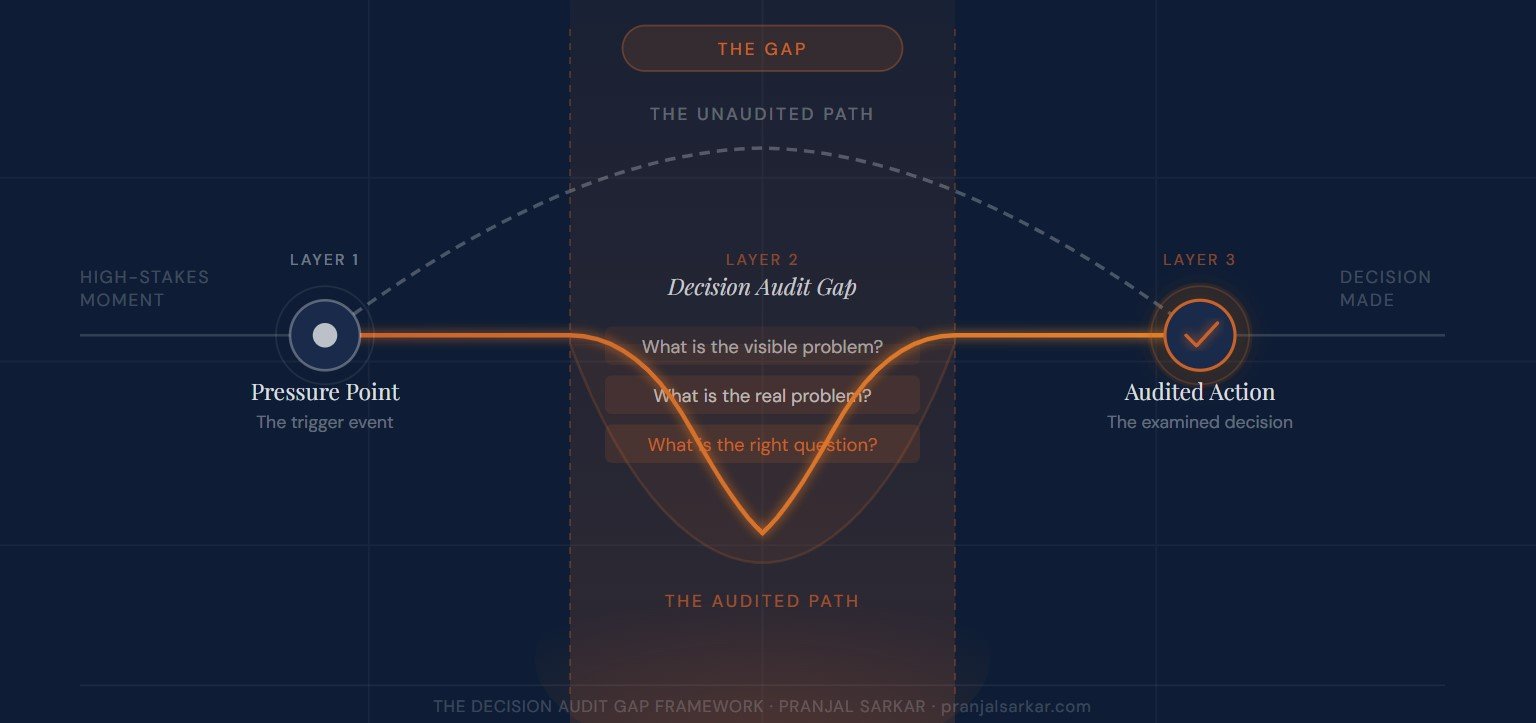
The diagram shows two paths. The unaudited path skips the gap entirely, going directly from pressure to action. It feels decisive. It feels productive. It produces the consequences described above.
The audited path goes through the gap. It examines three questions before committing to an action: what is the visible problem, what is the real problem, and what is the right question. The decision that comes out of the other side is not perfect. It is examined. That difference compounds over a career.
The Decision Audit Gap is not a theory. It is a structured practice. One that engineers apply before they ship. That doctors apply before they diagnose. That investors apply before they commit. And one that professionals facing high-stakes career and work decisions almost never apply, until now.
The Decision Audit Instruments are free because people need to experience what a structured audit does before they believe it. Each instrument examines one specific high-stakes professional moment, before you act on it. Pick the domain that matches where you are right now.
AUDIT CAREER DECISIONS
Free structured audits for the high stake career moments where thinking clearly is hardest. Built on peer-reviewed research. Free. No login required.
AUDIT AI & WORK DECISIONS
Structured audits for professionals navigating AI disruption, capability shifts, and the decisions that determine whether you stay relevant or fall behind.
AUDIT BIG LIFE DECISIONS
Structured audits for high-stakes professional commitments where the cost of an unexamined decision is highest and the pressure to act is strongest.
Helping leaders and professionals see when they are solving the wrong problem before it gets expensive.